
Bacteriostatic water: why it matters and how much to use
Bacteriostatic water is the 0.9% benzyl-alcohol diluent that keeps reconstituted peptides stable for 28 days. Here's the chemistry, the volumes, and the math.
Every lyophilised peptide vial needs a diluent before it can be used. The default, for the vast majority of peptides on the Klarovel catalogue, is bacteriostatic water. Understanding what it is — and why it's preferred over sterile water or saline — is the difference between a protocol that runs cleanly for 28 days and one that forces you to discard vials you haven't finished.
What bacteriostatic water actually is#
Bacteriostatic water (often abbreviated BAC water or BW) is a USP-grade sterile water for injection preserved with 0.9% benzyl alcohol. The base is the same as plain sterile water — pharmaceutical-grade H₂O, filtered, sterilised, and sealed in a rubber-stoppered glass vial. The addition is benzyl alcohol, an antimicrobial preservative that prevents bacterial growth when the vial is repeatedly punctured.
That 0.9% concentration is chosen deliberately. It's enough benzyl alcohol to inhibit common bacterial contaminants introduced by multiple needle draws, but low enough that the solution remains tissue-compatible for subcutaneous or intramuscular injection.
The key practical property: a BAC water vial, once punctured, remains safe for reconstitution and injection for approximately 28 days when refrigerated. That window is backed by USP sterility data showing preservative efficacy begins to degrade measurably after four weeks of refrigerated use under correct sterile technique.
Why not sterile water or saline?#
Sterile water for injection is identical to BAC water except for the benzyl alcohol. Without the preservative, the vial is single-use. After one draw, the remaining solution has no antimicrobial protection and should be discarded. For peptide protocols that dose two or three times a week from the same vial over 28 days, sterile water is impractically wasteful.
0.9% sodium chloride (saline) is used in hospital contexts for IV reconstitution of certain biologics. For most peptides discussed on Klarovel, saline changes the ionic environment in ways that can alter peptide stability. The sodium and chloride ions can accelerate aggregation or degradation of certain peptides (though not all). BAC water's neutral, low-ion environment is the safer default unless a product sheet explicitly requires saline.
Tap water or distilled water is not an option. Neither is sterile or preserved. The infection risk is not theoretical.
How much BAC water to buy for a typical protocol#
The math is straightforward once you know your reconstitution volumes.
Scenario: single-peptide, 12-week protocol#
A typical BPC-157 protocol uses a 5 mg vial reconstituted with 2 mL of BAC water every 28 days. At 3× weekly dosing over 12 weeks (36 doses), you'll consume roughly 3 vials of peptide. Each vial needs 2 mL of BAC water, so the protocol uses 6 mL of BAC water over 12 weeks.
A 10 mL BAC water vial covers that protocol twice. One 10 mL vial is enough for a single-peptide 12-week run.
Scenario: two-peptide protocol (e.g., BPC-157 + TB-500)#
Same cycle length, but now two peptides each reconstituted with 2 mL. That's 12 mL of BAC water over 12 weeks. A single 10 mL vial is not quite enough; you'll need two 10 mL vials (or one 30 mL vial). The second 10 mL vial will have leftover capacity — but remember the 28-day rule: don't open vial #2 until vial #1 is depleted or near expiry.
Scenario: GLP-1 or larger-dose protocols#
Semaglutide and tirzepatide protocols typically use higher reconstitution volumes (3–5 mL per vial). A 10 mg tirzepatide vial reconstituted with 3 mL and dosed weekly uses roughly 3 mL per month. Twelve weeks of weekly dosing uses a single 10 mg vial with 3 mL BAC water.
The Klarovel BAC water calculator handles all these scenarios. Input the peptides in your protocol and their dose schedules, and the tool returns a recommended BAC water vial count — usually one or two 10 mL vials for a standard 12-week protocol.
What to buy and what to look for#
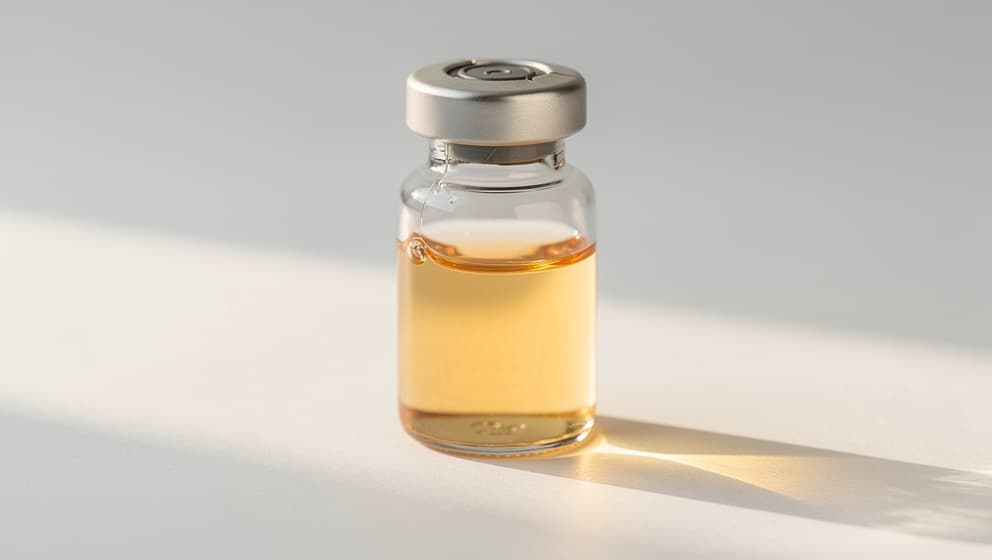
Klarovel's catalogue includes bacteriostatic water in the standard 10 mL vial size, which matches the 28-day vial-use window and pairs naturally with a standard 12-week protocol.
When choosing a BAC water source, look for three things:
- USP-grade labelling. The letters "USP" indicate the product meets United States Pharmacopeia standards for sterility and purity. This is the same grade used in pharmacy compounding.
- 0.9% benzyl alcohol concentration. This is the standard. Lower concentrations don't provide adequate preservation; higher concentrations are unusual and unnecessary.
- Intact glass vial with visible rubber stopper. The vial should be sealed at purchase. Avoid plastic bottles or vials without a rubber stopper — both are markers of non-injection-grade water.
The decision tree#
Three questions answer every BAC water decision:
- Am I reconstituting a lyophilised peptide? Yes → BAC water is the default.
- Will I draw from the same vial more than once? Yes → BAC water over sterile water.
- Does the peptide's product sheet specify saline? Rare, but if yes, follow that. Otherwise BAC water.
For protocol planning, the BAC water calculator takes your peptide list and dose schedule and outputs a concrete vial count. For the reconstitution procedure itself, the peptide calculator handles the concentration and unit math. Klarovel's intake questionnaire builds the full protocol — peptides, doses, cycling — in one pass.
Getting the diluent right isn't glamorous, but it's the difference between a clean protocol and a vial you end up discarding at day 20 because something went wrong. BAC water is the boring part. That's the point.
Keep reading

BPC-157 + TB-500 stack: what the evidence actually says
The BPC-157 + TB-500 stack is the most common healing peptide protocol. Here's the mechanism rationale, the dosing framework, and what the evidence does — and doesn't — support.
How to reconstitute peptides: a complete step-by-step guide
Peptide reconstitution is the step most people get wrong. Bacteriostatic water, sterile technique, dose math, storage — here's the evidence-based walkthrough.

Peptide dosing math: mcg, mg, IU, and syringe units explained
Peptide dose math is simple once you separate the three unit systems. Here's how mcg, mg, and IU relate — and how to read them off an insulin syringe.