
Peptide dosing math: mcg, mg, IU, and syringe units explained
Peptide dose math is simple once you separate the three unit systems. Here's how mcg, mg, and IU relate — and how to read them off an insulin syringe.
Three unit systems show up on peptide product sheets and syringes: micrograms (mcg), milligrams (mg), and international units (IU). Dose math gets confusing because instructions switch between them mid-sentence. Once the three are separated, the math itself is arithmetic.
Weight units: mcg and mg#
Peptides are dosed in weight. A typical BPC-157 dose is 250 mcg (micrograms). A typical MK-677 dose is 12.5 mg (milligrams). The conversion is constant:
1 mg = 1,000 mcg
Most peptides are dosed in mcg because the typical therapeutic range is below 1 mg. A 200 mcg dose of Ipamorelin is easier to read and discuss than 0.2 mg. A 12.5 mg dose of MK-677 is easier than 12,500 mcg. The units follow the scale.
Product sheets and vial labels vary in which unit they use. A "5 mg" BPC-157 vial contains 5,000 mcg. A "500 mcg" Ipamorelin dose is 0.5 mg. When a protocol specifies a dose, note the unit and stick with it for the rest of the math.
Volume units: mL and syringe units#
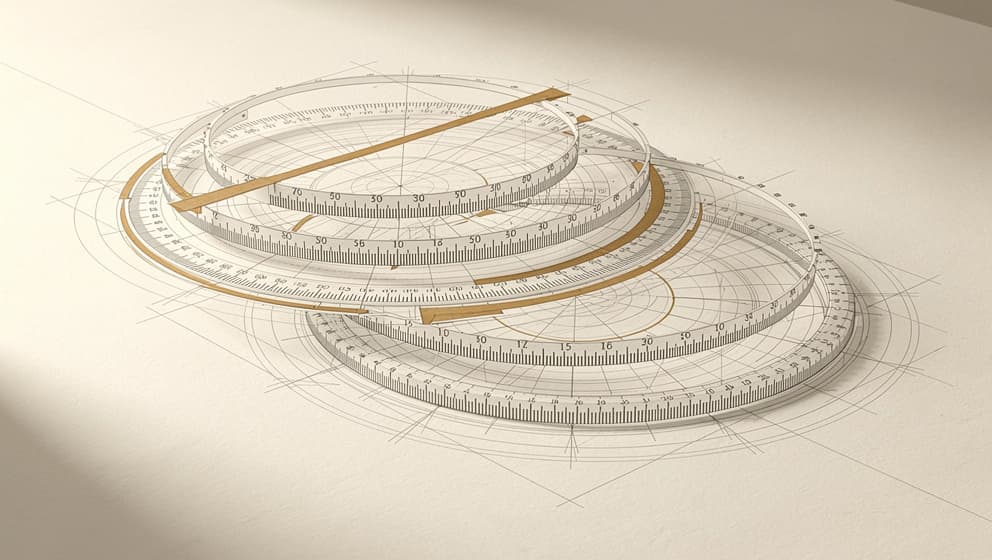
Reconstituted peptides are liquid. Syringes measure volume. The standard peptide syringe is a 1 mL insulin syringe marked in 100 units.
100 units = 1 mL
Other mappings follow:
- 50 units = 0.5 mL
- 20 units = 0.2 mL
- 10 units = 0.1 mL
That's all "units" means on an insulin syringe — a finer division of a millilitre. It has nothing to do with the weight of peptide inside.
The concentration bridge#
Weight (mcg or mg) and volume (mL or units) connect through concentration. Concentration is what you set when you choose a BAC water volume for reconstitution.
Concentration = peptide weight in vial ÷ BAC water volume
Examples:
- 5 mg BPC-157 + 2 mL BAC water = 2.5 mg/mL = 2,500 mcg/mL
- 10 mg Ipamorelin + 2 mL BAC water = 5 mg/mL = 5,000 mcg/mL
- 10 mg Tirzepatide + 3 mL BAC water = 3.33 mg/mL = 3,333 mcg/mL
Once you have the concentration, any dose converts to syringe units with one formula:
Syringe units = (target dose in mcg ÷ concentration in mcg/mL) × 100
Worked example#
Vial: 5 mg BPC-157 + 2 mL BAC water (concentration = 2,500 mcg/mL)
- 250 mcg dose: (250 ÷ 2,500) × 100 = 10 units
- 500 mcg dose: (500 ÷ 2,500) × 100 = 20 units
- 1,000 mcg (1 mg) dose: (1,000 ÷ 2,500) × 100 = 40 units
Same vial reconstituted with 5 mL of BAC water instead of 2 mL (concentration = 1,000 mcg/mL):
- 250 mcg dose: (250 ÷ 1,000) × 100 = 25 units
- 500 mcg dose: (500 ÷ 1,000) × 100 = 50 units
More BAC water dilutes the peptide. More dilution means more syringe units per dose — easier to measure, harder to overdose by a small margin.
International units: where they matter and where they don't#
IU (international unit) is a potency unit defined by biological activity, not by weight. Different peptides have different weight-to-IU ratios. The unit exists because early insulin, HCG, and HGH products varied in purity and potency, so a biological standard was needed.
Peptides in the Klarovel catalogue that use IU:
- HCG — dosed and sold in IU (e.g., 5,000 IU vials)
- HGH (not stocked as a standalone) — conventionally dosed in IU
Peptides that do not use IU:
- All GH secretagogues (CJC, Ipamorelin, Tesamorelin, Sermorelin, MK-677, GHRP-2, GHRP-6, Hexarelin, Hexarelin) — dosed in mcg
- All GLP-1 class (semaglutide, tirzepatide, retatrutide) — dosed in mg
- Healing peptides (BPC-157, TB-500, GHK-Cu, KPV) — dosed in mcg or mg
- Longevity peptides (NAD+, Epitalon, DSIP) — dosed in mcg or mg
For the IU peptides, the reconstitution math is the same, but substituting IU for mcg:
- 5,000 IU HCG + 5 mL BAC water = 1,000 IU/mL
- 250 IU dose: (250 ÷ 1,000) × 100 = 25 units on the syringe
Practical habits that prevent dosing errors#
Three habits make peptide dose math reliable:
- Stick to one unit system per protocol. If the peptide is dosed in mcg, keep all math in mcg. If it's in mg, stay in mg. Converting mid-calculation is where zeros go missing.
- Draw in daylight, not from habit. Insulin syringe markings are fine. A glance at the "wrong" mark under bad lighting is a common cause of over- or under-dosing.
- Use the calculator even once for a new protocol. The first dose of a new peptide should be measured against what Klarovel's peptide calculator says the draw should be. Once the sanity check aligns with the math you're doing in your head, the routine takes over.
One-minute summary#
- Peptide dose is weight: mcg or mg, with 1 mg = 1,000 mcg
- Syringe unit is volume: 100 units = 1 mL on a standard insulin syringe
- Concentration bridges the two: mcg per mL is the number you set during reconstitution
- Dose in syringe units = (dose in mcg ÷ concentration in mcg/mL) × 100
- IU is a potency unit. Used for HCG and HGH-class. Not used for any other peptide in the Klarovel catalogue.
For every specific case, the units converter handles mcg/mg/IU conversions, and the peptide calculator handles the full vial-to-syringe math in one step. The titration calculator adds a week-by-week escalation schedule on top. Between those three tools and the intake questionnaire, every dosing decision that matters has a structured answer.
Get the math right once. The rest of the protocol gets easier from there.
Keep reading
Bacteriostatic water: why it matters and how much to use
Bacteriostatic water is the 0.9% benzyl-alcohol diluent that keeps reconstituted peptides stable for 28 days. Here's the chemistry, the volumes, and the math.
BPC-157 + TB-500 stack: what the evidence actually says
The BPC-157 + TB-500 stack is the most common healing peptide protocol. Here's the mechanism rationale, the dosing framework, and what the evidence does — and doesn't — support.
How to reconstitute peptides: a complete step-by-step guide
Peptide reconstitution is the step most people get wrong. Bacteriostatic water, sterile technique, dose math, storage — here's the evidence-based walkthrough.