
Epitalon: the longevity peptide explained
Epitalon is a tetrapeptide associated with telomerase activity and pineal-gland regulation. Here's what the research actually shows — and where the evidence is thin.
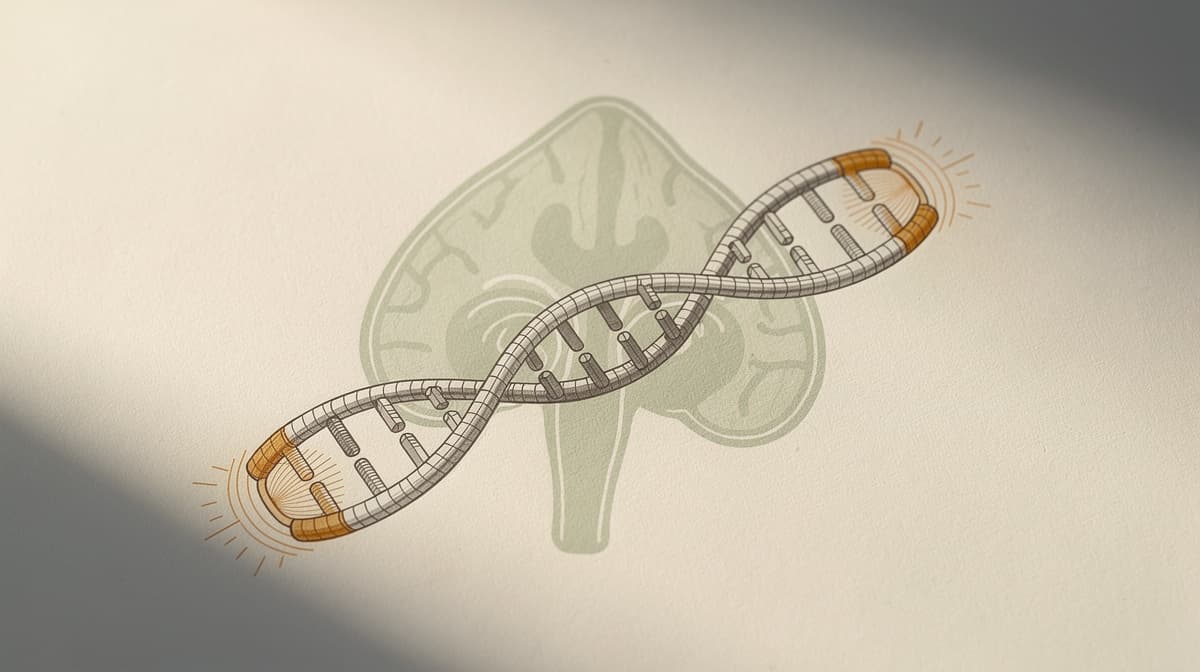
Epitalon (also spelled Epithalon) is one of the most-discussed longevity peptides in the research-use catalogue. It's a short, synthetic tetrapeptide claimed to activate telomerase, regulate pineal-gland function, and extend lifespan. The Russian research on Epitalon is substantial; the Western clinical research is minimal. Understanding what the evidence actually shows — and doesn't — is the key to a rational Epitalon protocol.
What Epitalon is#
Epitalon is a synthetic tetrapeptide with the sequence Alanine-Glutamate-Aspartate-Glycine (Ala-Glu-Asp-Gly). It was developed in the late 1980s by Vladimir Khavinson at the St. Petersburg Institute of Bioregulation and Gerontology as a short, stable peptide derived from Epithalamin, a complex extract of bovine pineal gland that itself showed life-extension and anti-aging effects in various animal studies.
The logic: isolate the bioactive fragment of the pineal-gland extract, produce it synthetically at higher purity, and study it in controlled research settings. Epitalon is that fragment. It is sometimes marketed as "Epithalon" — the terms are used interchangeably.
The mechanism claims#

Four mechanisms are commonly attributed to Epitalon in the research literature:
1. Telomerase activation. The most famous claim. Telomerase is the enzyme that maintains telomere length; telomere shortening is one of the hallmarks of cellular aging. Russian in vitro studies report that Epitalon induces telomerase activity in somatic cells that normally don't express it, leading to telomere lengthening and extended cellular replicative capacity.
2. Melatonin and cortisol rhythm normalisation. The original Epithalamin extract was pineal-derived; Epitalon inherits some pineal-axis activity. Research reports restoration of nocturnal melatonin peaks in older subjects with disrupted circadian rhythm, and normalisation of cortisol rhythm.
3. Antioxidant activity. Epitalon appears to reduce markers of oxidative damage in aged tissue, possibly through pineal-hormone-mediated pathways rather than direct antioxidant chemistry.
4. Gene expression modulation. Broader effects on gene transcription related to telomere maintenance, apoptosis resistance, and cellular repair.
What the evidence actually supports#

The evidence picture is mixed.
Strong in preclinical models: Russian research groups have published dozens of studies in animal models (rats, mice) showing consistent life-extension effects, reduced tumour incidence, and improved age-related functional markers with Epitalon administration. The preclinical signal is substantial.
Moderate in small clinical studies: A handful of open-label clinical studies in older adults report improved sleep quality, normalised hormone rhythms, and some biomarker improvements. Sample sizes are small (typically 30–100 subjects) and randomisation and blinding are not always rigorous.
Thin in large randomised trials: No Phase 3 clinical trial of Epitalon has been published in Western peer-reviewed medical literature. The claim "Epitalon extends human lifespan" rests on preclinical models and small clinical studies — it has not been tested in a large, rigorous randomised trial in humans.
Telomerase activation specifically — the most-cited claim — has limited independent replication outside the original Russian laboratories. Some Western research groups have looked and not found consistent effects in their models.
Honest framing: Epitalon has a substantial preclinical evidence base and a thin clinical evidence base. The mechanism is plausible, the hype outruns the data, and anyone choosing to use Epitalon should understand they're operating in a research-use context with limited large-scale human outcome data.
Dosing#

Typical research-use protocol:
- Dose: 5–10 mg per injection
- Frequency: once daily
- Route: subcutaneous
- Cycle structure: 10–20 day courses, 1–2× per year
- Alternate protocol: 5 mg daily for 10 days, repeated every 3–6 months
Some protocols use a "loading" approach (10 mg daily for 10 days) followed by an extended pause; others use lower doses more sustainedly (5 mg daily for 20 days, then 3–6 months off). The episodic-cycling approach is closer to the original Russian research protocols.
Reconstitution: a 50 mg Epitalon vial reconstituted with 2 mL of bacteriostatic water gives 25 mg/mL. A 10 mg dose = 0.4 mL = 40 syringe units. The peptide calculator handles any vial size.
Side effects#
Epitalon's short-term safety profile is benign across preclinical and clinical data:
- Mild injection-site irritation
- Occasional transient drowsiness after dosing (possibly related to pineal-axis effects)
- Brief mild headache in some users
- No drug interactions of clinical significance characterised
No serious adverse events have been reported in published Russian clinical trials at standard doses.
Regulatory status#
Epitalon is not approved as a medicine in the US, EU, or Norway. Legemiddelverket has not authorised Epitalon for any indication. In Russia, Epitalon and related pineal-gland-derived preparations (Epithalamin) have a longer regulatory history, with authorised use in geriatric applications under specific clinical conditions. That authorisation does not transfer to Western regulatory frameworks.
Klarovel stocks Epitalon in vial format suitable for research-use reconstitution.
The practical framework#
Three questions for anyone considering Epitalon:
- What's the goal? Circadian-rhythm restoration in users with disrupted sleep — particularly older adults — is where the evidence is strongest. Broad anti-aging and life-extension claims are where the evidence is thinnest.
- Is the cancer contraindication a factor? The theoretical telomerase-activation mechanism makes Epitalon the peptide with the most cautious cancer-history framing in the catalogue. For users with any history of malignancy, even remote, the risk-benefit isn't favourable.
- What's the cycle fit? Epitalon's episodic-cycle structure (10–20 days per course, 1–2× per year) is unusual. It doesn't stack continuously with daily protocols. Users typically run Epitalon courses as standalone interventions or paired with other longevity-focused peptides like NAD+.
For protocol planning, Klarovel's questionnaire handles screening. The peptide calculator handles dose math. For the related longevity context, see the NAD+ guide.
Epitalon is one of the more interesting peptides in the longevity research-use catalogue. The evidence base is unusual — substantial preclinical, moderate small-clinical, thin large-trial. The mechanism is plausible, the outcomes claims have outrun the data, and the cancer contraindication is worth taking seriously. Use it where the evidence is strongest (circadian-rhythm applications in older adults) and treat the broader life-extension claims as hypotheses the data hasn't confirmed yet.
Keep reading
Selank Peptide: Russian-Approved, Not FDA-Authorized
Selank peptide is a Russian-approved anxiolytic that modulates GABA-A and enkephalins. The mechanism, the 62-patient trial, and 2026 regulatory reality.

Semax Peptide: Approved in Russia, Unscheduled in the US
Semax peptide is a Russian-approved nootropic that raises BDNF and shows neuroprotective effects after stroke. The science and the 2026 regulatory reality.
Cognitive peptides: promise, evidence, and a retraction
Research-first walkthrough of cognitive peptides, what Semax, Selank, and DSIP actually do, which claims don't hold up, and what to watch in 2026.