
GHK-Cu copper peptide: what the research actually shows for skin and hair
GHK-Cu is the fastest-growing peptide in search volume. The copper complex is a legitimate biological signal — but the hype outruns the clinical data. Here's the real picture.
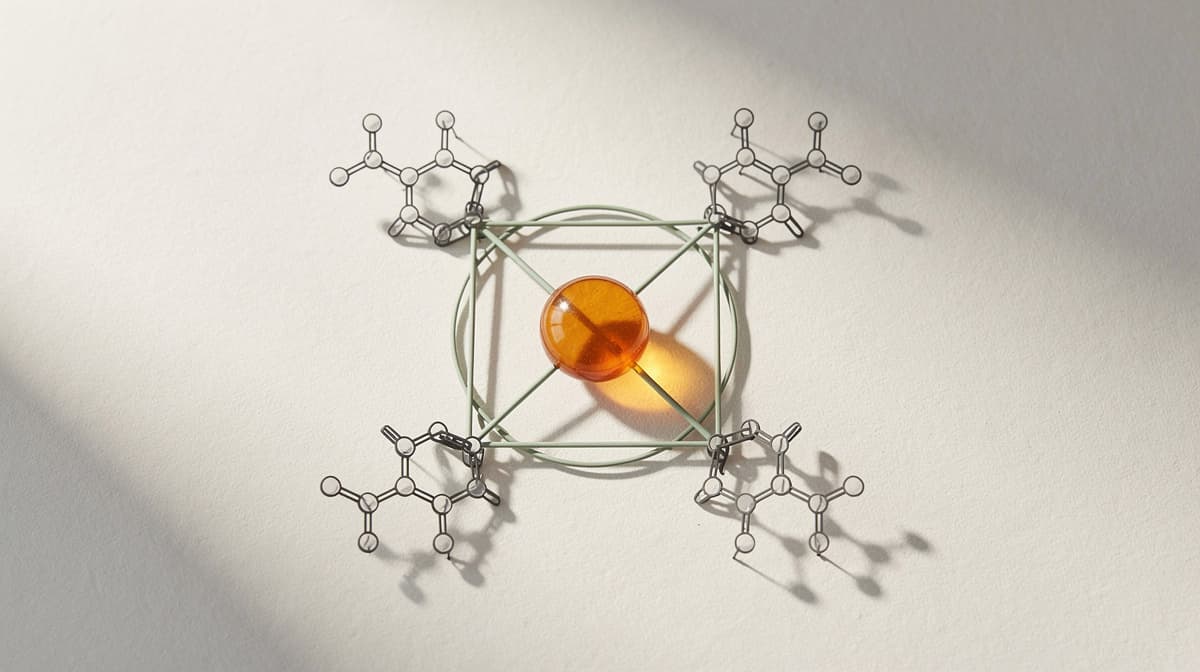
GHK-Cu is the fastest-growing peptide in global search volume — up more than 1,000% year-over-year in 2026. The molecule itself is real: a naturally-occurring tripeptide-copper complex with demonstrated biological activity on skin, hair, and wound-healing biology. The hype, however, outruns the clinical evidence. Understanding GHK-Cu means separating the mechanism from the marketing.
What GHK-Cu actually is#
GHK-Cu is shorthand for glycyl-L-histidyl-L-lysine bound to copper(II). The tripeptide sequence (Gly-His-Lys) has high affinity for copper ions; when bound, the peptide-copper complex takes on the pale blue colour characteristic of copper(II) coordination compounds.
GHK was first isolated from human plasma in the 1970s. Levels in plasma decline with age — roughly 200 ng/mL in people under 25, down to about 80 ng/mL by age 60. That age-related decline is part of the mechanistic argument for supplementation.
The copper ion matters. GHK without copper has some biological activity, but GHK-Cu (the copper-complexed form) has substantially more. Copper is a cofactor for lysyl oxidase (an enzyme critical for collagen cross-linking) and other enzymes involved in tissue remodelling.
The mechanism#

GHK-Cu's documented activities in preclinical and cell-culture studies include:
- Collagen and elastin synthesis — fibroblasts treated with GHK-Cu produce more collagen and elastin, supporting the skin-firmness use case
- Hair follicle stimulation — follicular dermal papilla cells respond to GHK-Cu with increased proliferation, supporting hair-growth applications
- Wound healing — accelerated re-epithelialisation and reduced scarring in dermal wound models
- Antioxidant activity — GHK-Cu scavenges reactive oxygen species, providing some protection against oxidative damage
- Anti-inflammatory effects — modulation of inflammatory cytokine expression
- Gene expression modulation — broader effects on gene transcription related to tissue repair and maintenance
The mechanism is broader than most peptides. That breadth is both the appeal (many possible benefits) and a reason for scepticism (broad mechanism claims often fail to translate to robust clinical outcomes).
Topical vs injectable#
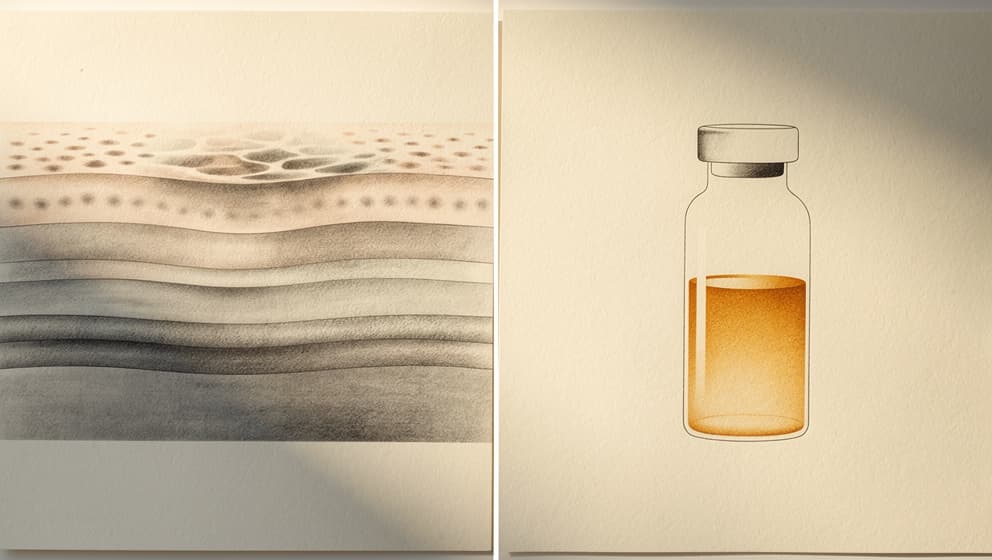
The strongest evidence for GHK-Cu is topical (applied to the skin):
- Decades of cosmetic and dermatological research
- Multiple clinical studies on skin firmness, fine lines, hydration
- Included in high-end skincare formulations globally
- Typical effective concentrations: 2–5% in the formulation, applied daily
Topical GHK-Cu is what sits in premium skincare products marketed in every major market. The evidence for its cosmetic effects on skin texture and appearance is reasonable.
The injectable evidence base is thinner. Subcutaneous injection of GHK-Cu has been studied for systemic effects on collagen synthesis and hair growth, but with smaller trials and less consistent outcomes than the topical literature. Injectable use is where research-use protocols and the fastest-growing search volume live — but it's also where the hype has the widest gap to close with the evidence.
Dosing#
Injectable (research use):
- Dose: 1–2 mg per injection
- Frequency: 2–3× weekly
- Route: subcutaneous, can be injected near scalp for hair-focused protocols or abdominally for systemic effects
- Cycle length: 8–12 weeks per cycle
Topical (cosmetic):
- Formulations at 2–5% GHK-Cu
- Applied to clean skin twice daily
- Avoid combining with topical retinoids on the same application (copper oxidises retinoids)
For the injectable path, a typical 50 mg GHK-Cu vial reconstituted with 2 mL BAC water gives 25 mg/mL. A 2 mg dose = 0.08 mL = 8 syringe units. The peptide calculator handles vial sizes.
Side effects#
Both topical and injectable GHK-Cu have benign side-effect profiles:
- Topical: occasional skin irritation, particularly in users with sensitive skin or copper sensitivity
- Injectable: mild injection-site irritation, transient blue-green discolouration at injection site (from the copper complex, cosmetic only), rare mild fatigue
The blue-green colour at the injection site is expected — it's the peptide-copper complex itself. It fades over hours as the peptide distributes.
Regulatory status#
Topical GHK-Cu is regulated as a cosmetic ingredient in most jurisdictions — no prescription required, standard cosmetic safety testing applies. Widely marketed in skincare products globally, including in Norway.
Injectable GHK-Cu is not approved as a medicine in the US, EU, or Norway. Legemiddelverket has not authorised injectable GHK-Cu for any indication. Research-use access only.
Klarovel stocks GHK-Cu in vial format suitable for research-use reconstitution.
The honest framing#
The case for GHK-Cu is strongest where the evidence is strongest: topical cosmetic applications for skin texture, fine lines, and age-related collagen loss. That evidence base is legitimate.
The case for injectable GHK-Cu for systemic effects — whole-body collagen synthesis, metabolic effects, broad anti-aging — is less well supported. The mechanism is plausible and the preclinical data is real, but clinical trials at scale haven't been run. Claims of dramatic systemic benefits should be treated with the same scepticism applied to any research-use peptide without Phase 3 evidence.
The growth in search volume reflects hype more than clinical evidence. GHK-Cu is interesting pharmacology — it's not the first peptide where interesting pharmacology translated slowly to real-world outcomes.
Practical framework#
Three questions for anyone considering GHK-Cu:
- Topical or injectable? For skin-quality goals, topical has better evidence and lower regulatory friction. For research-use systemic applications or hair-focused protocols, injectable has the research framework.
- What's the specific goal? Narrow, clear goals (wrinkle appearance, hair density support) are better matches for GHK-Cu than broad anti-aging intent. Broad goals are usually better addressed by multiple more-specific tools.
- What's the stack fit? GHK-Cu pairs reasonably with BPC-157 for wound healing, with peptide-based hair protocols for follicular support, or with topical routines for cosmetic outcomes. It's rarely a standalone protocol.
For research-use protocol planning, Klarovel's questionnaire maps goals and contraindications to recommendations. The peptide calculator handles dose math. For tissue-repair context, see the BPC-157 guide.
GHK-Cu is a real molecule with real mechanism. The hype is partly earned and partly market-driven. Use it where the evidence is strongest (topical cosmetic) and keep expectations realistic for research-use injectable applications.
Keep reading
Selank Peptide: Russian-Approved, Not FDA-Authorized
Selank peptide is a Russian-approved anxiolytic that modulates GABA-A and enkephalins. The mechanism, the 62-patient trial, and 2026 regulatory reality.
Semax Peptide: Approved in Russia, Unscheduled in the US
Semax peptide is a Russian-approved nootropic that raises BDNF and shows neuroprotective effects after stroke. The science and the 2026 regulatory reality.
Cognitive peptides: promise, evidence, and a retraction
Research-first walkthrough of cognitive peptides, what Semax, Selank, and DSIP actually do, which claims don't hold up, and what to watch in 2026.