
MK-677 (ibutamoren): the oral GH secretagogue explained
MK-677 is the only orally active growth hormone secretagogue in the catalogue. Here's how the mechanism, the dosing pattern, and the side-effect trade-offs actually work.
MK-677 (ibutamoren) is the only orally active growth hormone secretagogue in the catalogue. It activates the same ghrelin receptor that injectable GHRPs like Ipamorelin activate — but as a pill. That's both the appeal and the complication. The mechanism works; the side-effect profile is less clean than injectable GHRPs.
What MK-677 is#
MK-677 (development code; also called ibutamoren) is not a peptide. It's a small-molecule non-peptide agonist of the growth hormone secretagogue receptor (GHS-R) — the same receptor activated by ghrelin and by peptide GHRPs like Ipamorelin. Unlike peptide GHRPs, MK-677 survives gastric acid and oral absorption, making it the only GH-axis molecule that can be taken as a pill.
The pharmacological effect is essentially the same as Ipamorelin's at the receptor level: GHS-R activation triggers endogenous GH release from the pituitary. What differs is duration. Ipamorelin's half-life is under an hour, producing a pulsatile GH release pattern. MK-677 has a ~24-hour half-life, producing sustained receptor activation — which translates to elevated GH pulses across the full circadian cycle rather than discrete pulses.
Mechanism and expected effects#
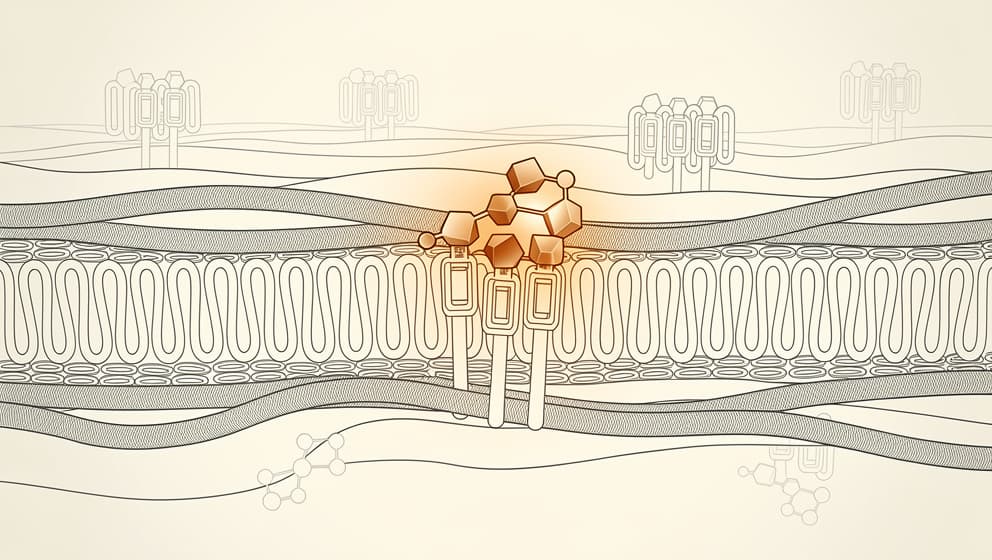
MK-677's sustained receptor activation produces several well-documented effects over 8+ week cycles:
- Elevated IGF-1 — the downstream marker of GH-axis activation typically rises 40–100% above baseline
- Increased fat-free mass — lean mass gains of 1–2 kg over 8–12 week cycles are common
- Improved sleep quality — deeper, more restorative sleep is one of the most-reported subjective effects
- Increased appetite — direct ghrelin receptor activation is a hunger signal, often pronounced with MK-677
The sustained activation pattern is mechanistically different from pulsatile GHRP use. Some research suggests the sustained pattern produces receptor desensitisation faster than pulsatile, which informs cycle-length recommendations.
Dosing#

- Dose: 12.5 mg or 25 mg once daily
- Timing: evening (matches natural GH pulse circadian rhythm)
- Cycle length: 8–12 weeks on, followed by 4–8 weeks off
- Route: oral
The 12.5 mg dose is the typical starting point. 25 mg produces larger IGF-1 elevation but also larger side-effect signal. Beyond 25 mg, diminishing returns on IGF-1 are paired with exponentially worse side effects.
Side effects and trade-offs#
MK-677 has a more substantial side-effect profile than injectable GHRPs, primarily because of its sustained receptor activation:
- Increased appetite — the ghrelin mimetic effect on hunger is pronounced. Many users report significant hunger, particularly in the first 2–4 weeks.
- Elevated fasting glucose — GH-axis activation reduces insulin sensitivity. Fasting glucose typically rises 0.3–0.7 mmol/L during a cycle. HbA1c may rise modestly.
- Water retention — common, particularly in the first 1–3 weeks. Usually cosmetic rather than clinically significant.
- Vivid or unusual dreams — related to GH-axis effects on REM sleep architecture
- Mild lethargy — particularly the morning after evening dosing
- Tingling or numbness in extremities at higher doses (same mechanism as with Ipamorelin but more common due to sustained activation)
The glucose signal is the one that matters most. Users with any baseline glucose dysregulation — pre-diabetes, type-2 diabetes, or consistently elevated fasting glucose — should avoid MK-677. For users with normal baseline glucose, bloodwork at 4–6 weeks can flag the change before it becomes clinically significant.
Regulatory status#
MK-677 is not approved as a medicine in the US, EU, or Norway. Legemiddelverket has not authorised MK-677 for any indication. Research-use only.
Klarovel stocks MK-677 in a 50 mg pen format (administered as measured drops or integrated oral-dose delivery depending on product specification).
MK-677 vs injectable GHRPs#

The choice between MK-677 and injectable GHRPs (usually Ipamorelin stacked with CJC-1295) comes down to trade-offs:
| MK-677 | Ipamorelin + CJC-1295 | |
|---|---|---|
| Route | Oral (pill / drops) | Subcutaneous injection |
| Half-life | ~24 hours (sustained) | ~30 min (pulsatile) |
| Daily doses | 1 | 1–3 |
| IGF-1 elevation | Strong, sustained | Moderate, pulsatile |
| Appetite effect | Pronounced increase | Mild |
| Glucose impact | Meaningful elevation | Minimal at typical doses |
| Cortisol/prolactin | No elevation | No elevation (Ipamorelin) |
| Cost per month | Typically higher | Typically lower |
For users who want oral-only dosing and don't have glucose concerns, MK-677 is straightforward. For users who want cleaner side-effect profile or already have any glucose dysregulation, the injectable stack is the better choice.
The honest framing#
MK-677 works. The IGF-1 data is real, the sleep improvement is real, the lean-mass effects are measurable. It's also the GH-axis peptide with the least clean side-effect profile — glucose impact alone is enough to disqualify it for a significant portion of users who'd otherwise be candidates.
For anyone considering MK-677:
- Baseline HbA1c and fasting glucose are non-negotiable. Repeat at 4–6 weeks into the cycle.
- Monitor IGF-1. Rising above age-adjusted reference range means dose reduction or cycle pause.
- Cycle discipline matters. Sustained receptor activation tolerates desensitisation less well than pulsatile stimulation. 8–12 weeks on, followed by 4–8 weeks off, is the standard framework.
For protocol planning, Klarovel's questionnaire screens for contraindications including the glucose flags that matter most for MK-677. For the injectable alternative, see CJC-1295 + Ipamorelin stack and Ipamorelin complete guide.
MK-677 is the right peptide for a specific profile: users who want oral dosing, have clean glucose baselines, and understand the appetite and water-retention trade-offs. For that profile, it works. For anyone outside that profile, the injectable stack is almost always the better tool.
Keep reading
Selank Peptide: Russian-Approved, Not FDA-Authorized
Selank peptide is a Russian-approved anxiolytic that modulates GABA-A and enkephalins. The mechanism, the 62-patient trial, and 2026 regulatory reality.

Semax Peptide: Approved in Russia, Unscheduled in the US
Semax peptide is a Russian-approved nootropic that raises BDNF and shows neuroprotective effects after stroke. The science and the 2026 regulatory reality.
Cognitive peptides: promise, evidence, and a retraction
Research-first walkthrough of cognitive peptides, what Semax, Selank, and DSIP actually do, which claims don't hold up, and what to watch in 2026.